Benefits of Kitchen Remodeling
Why You Should Consider A Kitchen Renovation
Remodeling your kitchen is an excellent way to breathe new life into your home. Whether you are ready to embark on a full kitchen remodel or you want to modernize a few features, updating your kitchen will bring about a number of benefits. Keep reading to learn more about five benefits you’ll get from a kitchen renovation!
Improve functionality
The kitchen is the heart of the home and it tends to be a gathering place for families. There are many different ways you can improve the overall function of your kitchen. For example, you can add more cabinets or build an island to provide more storage and counter space. Or if you want to take the kitchen remodel even further, you can knock down the wall between the living room and kitchen in order to allow for a more open floor plan. A well-designed kitchen will make cooking and cleaning more efficient.
Add valuable living space
Older kitchens can feel cramped compared to modern kitchens with open floor plans. Kitchen remodeling gives you the freedom to make various changes to the layout. A great room that combines the kitchen with the dining room and the living room makes socializing easy. A spacious kitchen with fewer walls also gives the person who’s cooking or cleaning the ability to watch television or converse with people in other rooms.
Increase the value of your home
Kitchens and bathrooms play a large role in determining your home’s value on the market and its comparative value to other homes in the community. If you think you might sell your home in the future, a kitchen remodel goes a long way when it comes to improving your home’s value and encouraging a quick, easy sale
Improve sustainability
Kitchen remodeling allows you to upgrade your appliances to more eco-friendly models. You can install water-saving faucets to reduce your water usage. These types of upgrades will reduce your energy costs and your long-term carbon footprint. You can also incorporate more sustainable materials for your floors, cabinets, or countertops such as bamboo, cork, or salvaged wood. A sustainable kitchen will add to the value of your home and it often attracts homebuyers if you’re looking to sell.

Tips for Your Kitchen Facelift
If you’re content with the size and layout of your kitchen but are unhappy with how outdated and worn it looks, you’re ready for a kitchen facelift. Updating kitchen surfaces and details without altering the basic layout is also known as a pull and replace by the remodeling industry. It’s a relatively quick and more affordable way to have a new kitchen.
Revitalize Cabinets
New doors on existing cabinets gives you a massive change without the higher expense and time of all new cabinetry. Re-staining, painting, or adding trim to flat panel doors are other options to revive the appearance of timeworn cabinets. New hardware – aka knobs and pulls – will immediately enhance and distinctively update the look.
Replace Countertops
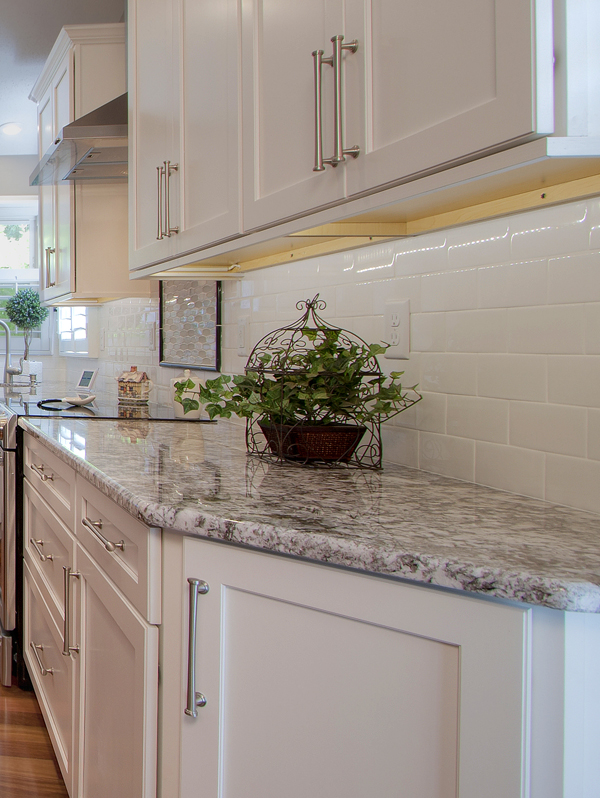
After cabinets, countertops are the most prominent focal point of the kitchen. You can splurge on natural stone like granite or marble (shown above). But you can make a big impact with less costly counter materials like onyx, laminate, wood or Corian.
Install a New Faucet
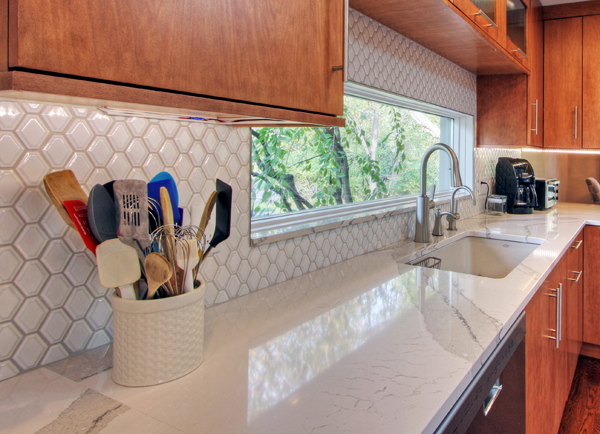
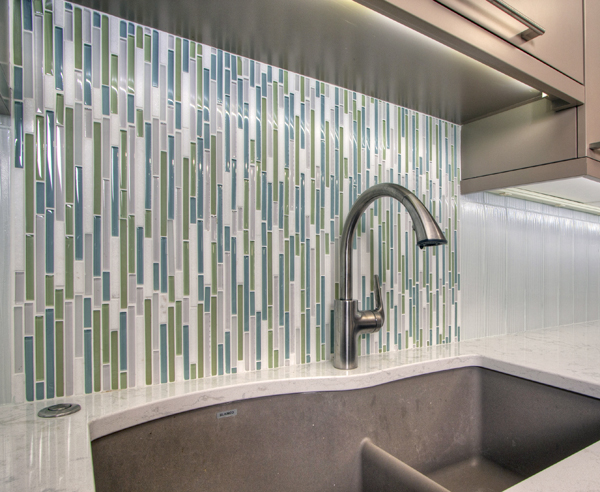
A functional item like a faucet need not be utilitarian. Faucet choices are endless – here’s a nice Kohler starting point. Consider choosing a finish that matches your new cabinet hardware for a nicely tailored effect. Shown above is the KWC Domo pull-down faucet.
Add Trim & Molding
One of the most overlooked ways to change the look of kitchen is with the addition of trim and molding. Adorning the ceiling with crown molding, wainscoting crested with a chair rail, or the augmentation of existing trim around doors and windows are some of the artful options that add style and polish.
How to Remodel Your Kitchen Without Renovating
When it comes to the happiness we associate with our homes, few things send spirits soaring quite like a brand-new kitchen. But, realistically, this isn’t an option for all of us. Those who are renters or have perennially tight budgets often feel that they are forced to make do with what they currently have.
But wait, there’s another alternative: They could give their kitchens a “no-renovation renovation.” That’s where you give your kitchen a whole new look without ripping out cabinets, replacing countertops, or otherwise spending big bucks (or violating your rental agreement to leave the place as you found it).
Paint your cabinets
One of the easiest changes you can make to the overall aesthetic of your kitchen is to change the color of your kitchen cabinets. “Painting your kitchen cabinetry is the best way to create a dramatic impact on a shoestring budget,” says
Even if you’re dealing with an outdated 1960s, ’70s or ’80s kitchen, fear not—refreshing and changing up the color can make one of the biggest differences and render the year it was built virtually impossible to detect. (As with all of these tips, if you’re a renter, be sure to get your landlord’s permission first.)
“In a small kitchen, you can remove the doors from the upper cabinetry and paint the insides a bright color as a fun way to add temporary and unexpected color to the space,” he says. If a minimalist look is more your speed, “keep it all white, and go for a more millennial ‘floating shelf’ vibe that keeps the space feeling open.”
How to renovate your kitchen on a budget, with minimal stress
Another holiday season has passed, and with it the marathon cooking and baking sessions. The hours spent using every kitchen appliance and inch of counter space had a potential benefit more lasting than a good meal: When we really use our kitchens, we discover what does and doesn’t work in this very important room.
Step one is deciding what really needs to be done. Can you work with the appliances and cabinets you’ve got, or is it time for a full-scale remodel?
STORAGE
A smoothly functioning kitchen has space for everything to be stored away, within reasonable reach. Can you achieve that with your current cabinets? If so, suggests keeping them and just replacing or refinishing the doors. “Cabinetry installation adds a lot to a budget,” he says, “so saving by simply reusing what you’ve got can be a massive help.”
If your cabinet doors are stained wood, consider painting them. Then, change the hardware. Drawer pulls and cabinet door handles “can make or break the look of the space,” says of the Atlanta-based design firm Pieces. Take time choosing new ones.
“I always use high-end hardware regardless of how high or low my budget is,” he says. “Adding an interesting metal and finish to your doors just really adds character and uniqueness. You can never go wrong with dull black pulls and knobs, and I’m also a huge fan of antique brass. When it comes to silver tones, I try to stay classic and go with polished nickel.”
Kitchen Demolition from Top to Bottom
Straightforward Kitchen Demolition Tips for DIYers
Even if you’re hiring contractors to handle the remodel, making your kitchen demolition a DIY job is a great way to keep more money in your project budget. And just about any homeowner can do it. The job doesn’t require any specialized skills and you probably already own all the tools you need. Read on to learn how to demo a kitchen yourself.
What Does Kitchen Demolition Cost?
Hiring professionals for your kitchen demolition costs between $500 and $750 on average. But that number can easily run as high as $1000 if you have a large kitchen or are demolishing down to the studs. For a DIYer, assuming you’ve got a basic tool box on hand, the only expense is debris removal (we’ll talk more about this in the prep stage below). This means gutting your kitchen yourself can save hundreds in your remodel budget.
Rent a Dumpster
Before you get to work, rent a home dumpster to clean up as you go. Between your appliances, cabinets, countertops, flooring and backsplash, gutting a kitchen will leave you with plenty of debris that your trash service won’t take at the curb. So, if you’re not up for hauling it to the dump yourself, a dumpster is the best solution.
Clean Out “Keep” Items
Box up dishes, cookware, dish cloths and anything else you plan to re-home in your brand-new kitchen. Store them in another room where there’s no danger of being damaged when the hammers start swinging. This step also gives you the perfect opportunity to declutter and get organized.
Shut Off Utilities
It’s not safe to demo a kitchen while the utilities are still on. Turn off power to the kitchen by flipping the appropriate switch in your breaker box. There’s usually a circuit map showing which switch controls the kitchen, but if not, just use trial-and-error.