A Splendid Choice For Kitchen Remodeling

Benefits of Kitchen Remodeling

Why You Should Consider A Kitchen Renovation

Remodeling your kitchen is an excellent way to breathe new life into your home. Whether you are ready to embark on a full kitchen remodel or you want to modernize a few features, updating your kitchen will bring about a number of benefits. Keep reading to learn more about five benefits you’ll get from a kitchen renovation!

Improve functionality

The kitchen is the heart of the home and it tends to be a gathering place for families. There are many different ways you can improve the overall function of your kitchen. For example, you can add more cabinets or build an island to provide more storage and counter space. Or if you want to take the kitchen remodel even further, you can knock down the wall between the living room and kitchen in order to allow for a more open floor plan. A well-designed kitchen will make cooking and cleaning more efficient.

Add valuable living space

Older kitchens can feel cramped compared to modern kitchens with open floor plans. Kitchen remodeling gives you the freedom to make various changes to the layout. A great room that combines the kitchen with the dining room and the living room makes socializing easy. A spacious kitchen with fewer walls also gives the person who’s cooking or cleaning the ability to watch television or converse with people in other rooms.

Increase the value of your home

Kitchens and bathrooms play a large role in determining your home’s value on the market and its comparative value to other homes in the community. If you think you might sell your home in the future, a kitchen remodel goes a long way when it comes to improving your home’s value and encouraging a quick, easy sale

Improve sustainability

Kitchen remodeling allows you to upgrade your appliances to more eco-friendly models. You can install water-saving faucets to reduce your water usage. These types of upgrades will reduce your energy costs and your long-term carbon footprint. You can also incorporate more sustainable materials for your floors, cabinets, or countertops such as bamboo, cork, or salvaged wood. A sustainable kitchen will add to the value of your home and it often attracts homebuyers if you’re looking to sell.

Tips for Your Kitchen Facelift

If you’re content with the size and layout of your kitchen but are unhappy with how outdated and worn it looks, you’re ready for a kitchen facelift. Updating kitchen surfaces and details without altering the basic layout is also known as a pull and replace by the remodeling industry. It’s a relatively quick and more affordable way to have a new kitchen.

Revitalize Cabinets

New doors on existing cabinets gives you a massive change without the higher expense and time of all new cabinetry. Re-staining, painting, or adding trim to flat panel doors are other options to revive the appearance of timeworn cabinets. New hardware – aka knobs and pulls – will immediately enhance and distinctively update the look.

Replace Countertops

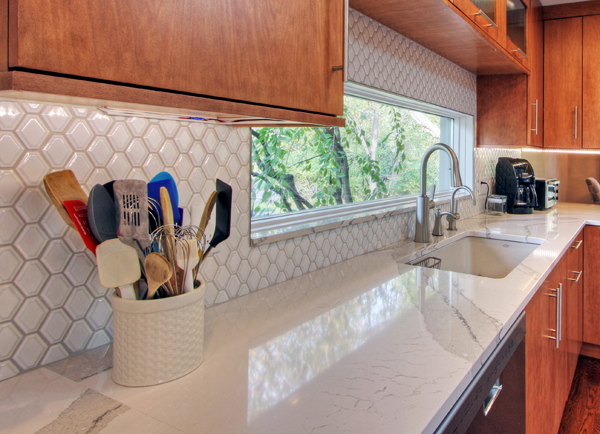
After cabinets, countertops are the most prominent focal point of the kitchen. You can splurge on natural stone like granite or marble (shown above). But you can make a big impact with less costly counter materials like onyx, laminate, wood or Corian.

Install a New Faucet

A functional item like a faucet need not be utilitarian. Faucet choices are endless – here’s a nice Kohler starting point. Consider choosing a finish that matches your new cabinet hardware for a nicely tailored effect. Shown above is the KWC Domo pull-down faucet.

Add Trim & Molding

One of the most overlooked ways to change the look of kitchen is with the addition of trim and molding. Adorning the ceiling with crown molding, wainscoting crested with a chair rail, or the augmentation of existing trim around doors and windows are some of the artful options that add style and polish.

How to Remodel Your Kitchen Without Renovating

When it comes to the happiness we associate with our homes, few things send spirits soaring quite like a brand-new kitchen. But, realistically, this isn’t an option for all of us. Those who are renters or have perennially tight budgets often feel that they are forced to make do with what they currently have.

But wait, there’s another alternative: They could give their kitchens a “no-renovation renovation.” That’s where you give your kitchen a whole new look without ripping out cabinets, replacing countertops, or otherwise spending big bucks (or violating your rental agreement to leave the place as you found it).

Paint your cabinets

One of the easiest changes you can make to the overall aesthetic of your kitchen is to change the color of your kitchen cabinets. “Painting your kitchen cabinetry is the best way to create a dramatic impact on a shoestring budget,” says

Even if you’re dealing with an outdated 1960s, ’70s or ’80s kitchen, fear not—refreshing and changing up the color can make one of the biggest differences and render the year it was built virtually impossible to detect. (As with all of these tips, if you’re a renter, be sure to get your landlord’s permission first.)

“In a small kitchen, you can remove the doors from the upper cabinetry and paint the insides a bright color as a fun way to add temporary and unexpected color to the space,” he says. If a minimalist look is more your speed, “keep it all white, and go for a more millennial ‘floating shelf’ vibe that keeps the space feeling open.”
How to renovate your kitchen on a budget, with minimal stress

Another holiday season has passed, and with it the marathon cooking and baking sessions. The hours spent using every kitchen appliance and inch of counter space had a potential benefit more lasting than a good meal: When we really use our kitchens, we discover what does and doesn’t work in this very important room.

Step one is deciding what really needs to be done. Can you work with the appliances and cabinets you’ve got, or is it time for a full-scale remodel?

STORAGE

A smoothly functioning kitchen has space for everything to be stored away, within reasonable reach. Can you achieve that with your current cabinets? If so, suggests keeping them and just replacing or refinishing the doors. “Cabinetry installation adds a lot to a budget,” he says, “so saving by simply reusing what you’ve got can be a massive help.”

If your cabinet doors are stained wood, consider painting them. Then, change the hardware. Drawer pulls and cabinet door handles “can make or break the look of the space,” says of the Atlanta-based design firm Pieces. Take time choosing new ones.

“I always use high-end hardware regardless of how high or low my budget is,” he says. “Adding an interesting metal and finish to your doors just really adds character and uniqueness. You can never go wrong with dull black pulls and knobs, and I’m also a huge fan of antique brass. When it comes to silver tones, I try to stay classic and go with polished nickel.”

Kitchen Demolition from Top to Bottom

Straightforward Kitchen Demolition Tips for DIYers

Even if you’re hiring contractors to handle the remodel, making your kitchen demolition a DIY job is a great way to keep more money in your project budget. And just about any homeowner can do it. The job doesn’t require any specialized skills and you probably already own all the tools you need. Read on to learn how to demo a kitchen yourself.

What Does Kitchen Demolition Cost?

Hiring professionals for your kitchen demolition costs between $500 and $750 on average. But that number can easily run as high as $1000 if you have a large kitchen or are demolishing down to the studs. For a DIYer, assuming you’ve got a basic tool box on hand, the only expense is debris removal (we’ll talk more about this in the prep stage below). This means gutting your kitchen yourself can save hundreds in your remodel budget.

Rent a Dumpster

Before you get to work, rent a home dumpster to clean up as you go. Between your appliances, cabinets, countertops, flooring and backsplash, gutting a kitchen will leave you with plenty of debris that your trash service won’t take at the curb. So, if you’re not up for hauling it to the dump yourself, a dumpster is the best solution.

Clean Out “Keep” Items

Box up dishes, cookware, dish cloths and anything else you plan to re-home in your brand-new kitchen. Store them in another room where there’s no danger of being damaged when the hammers start swinging. This step also gives you the perfect opportunity to declutter and get organized.

Shut Off Utilities

It’s not safe to demo a kitchen while the utilities are still on. Turn off power to the kitchen by flipping the appropriate switch in your breaker box. There’s usually a circuit map showing which switch controls the kitchen, but if not, just use trial-and-error.


Interior Painting Tips For Beautiful Rooms

Interior Painters on Thumbtack cost

The national average cost to paint a single room is $917. That price goes up to $1,223 for two rooms, $1,834 for three rooms and $2,446 for four rooms.

Prices depend on a variety of factors, including the size of your room, the type of paint, primer or finish you choose, how many coats you need, your ceiling height and the cost of hiring painters in your area.

How much do professional painters charge an hour?

The national average cost for professional interior painters is $45 per hour. However, average prices can range from $27 to $85 per hour depending on the painting company or contractor. 

If you feel like you haven’t been quoted a fair price, ask your painter to break down the numbers. Some painting companies include charges for things you wouldn’t ordinarily think about, such as materials, gas for traveling, and overhead expenses like utilities and crew benefits.

How to estimate the cost of painting a room

It’s helpful to ask yourself the following questions when you’re estimating how much you’ll pay for interior painting services.

How many interior rooms need to be painted? Your prices will go up if you need more rooms painted. However, the cost of painting two rooms is generally not double the cost of one room. You can spread out overhead expenses — an extra room just adds more square feet, some extra time and more gallons of paint.

How high is my ceiling? The higher the ceiling, the higher the walls — and that means more time and more paint.

How do painters set their prices? Ask the pro whether they charge per room, per square foot, per hour, per project or if they use a different cost unit.

How large is my room? Your room’s size or total square footage may have a large impact on your overall price. For an accurate quote, have measurements of your room ready when you contact a professional.

HOW TO PAINT RV WALLS

Use these RV interior painting ideas and tips to learn exactly how to paint RV walls. We’re breaking down the exact steps we used to paint our RV walls, cabinets and ceiling to give our camper a brand new look! This is a RV remodel project you don’t want to miss.

Paint is one of the easiest (and cheapest) ways to transform any space. That’s especially true when it comes to remodeling an RV. Painting the interior of an RV can be intimidating, but don’t worry, you can handle the project!

Prep The Walls For Paint

Whether you’ve completely gutted your RV or just wanting to give it a fresh paint job, you’ve probably got some imperfections in the walls.

Sanding The Walls

While sanding the walls of an RV, you want to be careful not to destroy the outer layer of the RV wall panels. This outer layer seems kind of like wallpaper, but it’s actually usually made from vinyl.

Wash the Walls with TSP

Once you’ve finished sanding, and filling all the holes, it’s time to clean the walls to prepare for paint. While it’s always a good idea to wash down an area before painting, it’s extra important to do so before painting RV walls and ceilings. With all the hauling, camping, and in our case, demo-ing, the interior of RVs can get dirty quick.

Wallpaper vs Paint: Insider Info You Need to Know

Looking for a way to breathe new life into your lacklustre walls? Deciding on the right type of wall treatment is no easy task, given the huge number of products available today. And homeowners are mostly confused between two popular options – paint vs wallpaper

Variety in colors and finishes is a major plus point if you are looking to create a unique look for your home. Thankfully, there is no dearth of variety in both wallpaper and paint.

Paint is available in literally every color under the sun – you can mix and match to your heart’s content. When applied in combination with the hundreds of texturing techniques in use today, paint can create stunning effects that completely transform the look of any home.  You can also choose from a variety of finishes such as matte, satin, semi-gloss and glossy.

Between the two, paint is the easier and less fussy option for walls. A day or two will suffice for a paint job for a standard size room. Painted walls are also very accommodating to incoming, newer coats of paint of the same hue. In most cases, if the surface isn’t too worn out, a new coat of paint can be applied on to the older one.

Good quality paint on walls, when finished well, can last you up to five years. That said, paint tends to fade and flake in areas that have high usage and exposure to sunlight. Hence, retouching will be necessary 3 years or so – maybe even sooner for paints in lighter colours.

Best Paint Colors For Your Living Room

Your living room is probably the most popular room in the house, so decorating it to make sure it’s a place that you actually look forward to spending time in a must. And that brings us to color, since coming up with a palette will likely drive the design process and set the mood for years to come. Whether you want something bold and bright, neutral, or moody, we’ve got tons of living room paint color ideas for your to get inspired by ahead. All you have to do is put on your overalls and grab a roller

Mint Green

This fresh color makes a room feel like a tropical oasis. In this room, where the paint stretches all the way up to the high rafters in this living room, the hue changes depending on the way the light hits it, shifting between sharp mint green and soft sea foam green.

Crisp White

A crisp, matte white is totally timeless. Pure White is there for you when you just can’t with trends anymore (see ya never, millennial pink).

Ocean Blue

Not only is this deep blue paint a lovely and bold color for the living room, but the high-gloss finish in this room by Kate Reid also adds some extra punch. It’s basically the color of wanderlust right in your own home. It’ll make you feel like you’re on vacation, even if the closest you’re getting to an island escape is your laptop’s screensaver (sigh)

Dark Gray

The mix of cool and warm tones in this designer living room strikes the perfect balance. Even though it’s subtle, the added texture you get from linen helps tone down the cool sophistication of the gray wall. And in a bold, colorful coral shade, it also cheers things up.

Painting Tips & Techniques

Which paint brush do I use for various types of paints?

A natural bristle paint brush is made from animal hair, and is very soft and porous. For oil-based paints, most professionals choose a natural China-bristle (hog hair) paint brush.

If you are painting a smooth surface with oil-based paint, a natural White Bristle paint brush is your best choice because it is soft and supple. When painting a textured surface, a natural Black Bristle paint brush will work better, because it is stiffer and has superior abrasion wear. When you require an ultra-fine finish, a brush blended with ox hair is the best choice.

Synthetic filament – When your choice in coatings is water-based (frequently referred to as latex), it is absolutely essential that you select a synthetic filament paint brush. The Purdy synthetic filament range includes:

100% black nylon

100% dyed nylon

Nylon/polyester blend

100% Chinex® filament

Chinex/nylon blend

Chinex/polyester blend

Chinex/nylon/polyester blend

Which paint roller is the best choice for various types of paints?

Most people believe that all paint rollers look and feel similar, but it’s important to keep the following painting tips in mind to achieve professional painting results:

Woven roller cover – Paint rollers that are made of woven material, such as the Purdy White Dove roller cover, are virtually shed-free because they are made out of continuous yarn. Every thread that makes up the face fabric is locked to the back of the fabric. These roller covers are recommended for smooth surfaces such as doors, paneling and smooth walls.

Knitted roller cover – Paint rollers that are made out of knitted material are usually used for rough or semi-rough surfaces, such as rough-cut siding, stucco or textured walls and ceilings. We recommend the Purdy Golden Eagle paint roller. This roller cover contains a high-density material that will hold a lot of paint without dripping.

Selecting the pile (or nap) – The more texture desired, the higher the pile should be. A 1/2-inch plus pile height is ideal for a stippled effect common to most homes. Pile heights on some Purdy textured paint roller covers are as high as 1-1/4 inches, creating an extremely textured effect. Conversely, if you desire a smooth finish in your kitchen, bath or utility room, use low-pile 1/4-inch to 3/8-inch roller covers such as the White Dove and Parrot paint roller covers.

Painting tips for cutting in with Purdy brushes.

“Cutting in” is the art of drawing a straight line, separating two colors using only the paint brush – no masking tape or other aid. You often see it at the edge where a wall color is cut into a different ceiling color. When cutting in, follow these simple rules:

Use a fully loaded brush.

Using the brush parallel to the area to be cut, let the paint brush open up into a semi-oval and bring it into the line you are cutting. Follow the line until the line of paint begins to break up. Repeat. It is best to cut in while breathing out or holding your breath.

Work into the previous area

The Most Suitable Laminate Flooring Choice

How to Clean and Remove Stains From Laminate Floors

How Often to Clean Laminate Floors

Laminate floors should be dust mopped or vacuumed daily to remove surface dirt and grit that can cause scratches and wear down the finish of the floor. Don’t forget to look under area rugs that can trap grit that will scratch floors. Spills and muddy messes should be cleaned immediately. Depending upon the amount of traffic on the floors, they should be thoroughly cleaned at least weekly.

Instructions

  • Dust Mop or Vacuum Floor

Get yourself a dust mop or a vacuum cleaner to remove surface dirt. These gritty particles will be picked up by the wet mop and get spread around the floor. At best, they’ll contribute to streaks and residue. At worst, this grit will scratch and pit the surface of your floor. If you use a vacuum cleaner, choose a machine with a setting for hard floors, as vacuums with rolling brushes can scratch and damage laminate over time.

  • Choose a Cleaning Solution

An expensive laminate floor cleaner is not always the best answer. Choose a cleaner that is designed to work with your floor type and also fits your budget or, better yet, make your own solution using vinegar or even a little rubbing alcohol. And whatever solution you choose, don’t overdo it. While using tons of cleaner on a dirty floor is tempting, it leaves behind a residue that dulls the floor’s finish. This residue is the leading cause of muted-looking laminate floors over time.

  • Damp Mop Floors

Water and other liquids can seep in between the laminate boards and cause swelling, ultimately damaging your floor. When cleaning, keep water use to a minimum and only spray as much cleaner onto the floor as you need for a given section. If you’re using a traditional mop, wring it out until it’s barely damp. If an excess of water or liquid is left behind to dry, you’re using too much: the floor should dry within one to two minutes of mopping.

  • Buff to a Shine

If you really want to make your floor shine after mopping, buff it dry. An absorbent cleaning cloth attached to a dust mop works well, as does a dry, microfiber mop head. Cloth diapers make a great DIY option and microfiber cleaning cloths work well for an ultimate hands-and-knees job. Work in circles with your tool of choice and gently buff each section of the floor for a nice shine.

Tip

  • Once your floor is looking great, it’s time to take protective measures to keep it that way. Place both indoor and outdoor floor mats at the entrances of your home. Consider a no-shoe rule in the house and put a little reminder in the mudroom. Wipe up spills, messes, and plant watering overflow as soon as it occurs. And use protective floor pads on the bottom of chairs, couches, and tables to prevent your floor from aging or premature damage.

General Cleaning for Laminate Floors

First and foremost, always follow the manufacturer’s care instructions for your new laminate floor. Don’t hesitate to call your manufacturer with questions; it’s better to be safe than sorry. If you inherited a laminate floor when you moved in, plan on taking care of it by sweeping, dusting, or vacuuming up loose dirt. Sweep or vacuum in the direction that your floor is laid to catch debris between the interlocking pieces. Wipe up all spills right away, including dry materials that fall.

Light damp mopping will help if simply wiping is not enough. Exercise caution; avoid overly wet mopping, which can result in water seeping behind baseboards. If there is standing water on the floor after mopping, dry it with a microfiber cloth. When you do mop, use two buckets of water—one for clean water, and one for dirty water. Using a dirty mop head on your floors is usually the reason why annoying streaking appears afterwards. Before you mop, vacuum first instead of sweeping. Vacuuming is much more effective at picking up particles. Just be sure to switch your vacuum setting to a soft brush. Rotating bristles on standard brushes can scratch a laminate floor. Water is really all you need to clean your floor. If you must use cleaner, opt for a manufactured-approved solution designed for laminate. For a homemade laminate floor cleaner, use a small amount of vinegar mixed with water. Never use wax, acrylic products, or bleach because they can damage the floor’s finish.

Deep Cleaning

When it comes to deep cleaning laminate flooring, less water is best. That’s because too much water can cause the wood to swell or bubble, fade or make seams separate,  While you can use a cleaning product designed specifically for laminate flooring, or you can mix a teaspoon of unscented clear dish soap into a gallon of water. Use a microfiber mop and be careful not to soak the floors. Use this damp mop method every two to three months.

What About Steam Cleaning?

While a steam cleaner is great at getting grim out of some hard-flooring surfaces, it should not be used when cleaning laminate floors. “The intense heat and moisture it uses to get the job done can also wreak havoc on the adhesive used on your laminate floors. “Once the steam and moisture break down the adhesive holding the laminate down it will begin to bubble up and may even come loose.”

Routine laminate floor cleaning

When it comes to cleaning laminate flooring regularly, a quick sweep and dry brush is all it takes to keep dust, dirt and debris at bay. If you want to give an even more thorough clean, you can use a vacuum.

Before vacuuming, always ensure your vacuum is set to a soft brush as rotating bristles on standard brushes can scratch laminate flooring.

If you’re looking to wipe down the entire surface of your laminate flooring, you can use a mop. But as mentioned, it’s important to keep water levels to an absolute minimum. A mop that has been well-rung and left to stand for ten minutes contains the maximum amount of moisture necessary to clean laminate floor and won’t pose a threat to the wooden composite core. Carpet Call’s Hard Flooring Cleaning Kit is the perfect solution to this problem, as it leaves your laminate floors clean and ready to walk on in 15 minutes after use.

Tip: Close Laminate Floor Plank Gaps to Prevent Damage

Laminate flooring’s particle wood core resists water only when the planks are tightly locked, allowing no moisture to seep downward. Some laminate floors inadvertently have open seams. If your floor has developed gaps near high moisture areas, such as around the kitchen sink or dishwasher, close those gaps to avoid damage to the floor. 

To permanently fix this area, run a thin bead of carpenter’s glue in the gap, push the boards together, and then quickly wipe off the excess glue. Lay a strip of painter’s tape over the fix until the glue has dried.

Avoid These Laminate Floor Cleaning Mistakes

No Wet Mops

Wet mops of the same saturation as you might use for a vinyl or concrete floor should be avoided at all times. Keep anything but the driest damp mop away from your floor.

No Waxes or Polishes

Never use waxes or polishes on your laminate floor. Your floor’s surface treatment is already built into the wear layer.

No Abrasives

Abrasive cleaners or anything remotely abrasive should be kept away from your laminate floor. This includes cleaners like Clorox or Bon Ami. While your laminate floor’s wear layer is surprisingly good at avoiding fine scratches, abrasive cleaners will dull it down.

No Steam Cleaning

Steam cleaners are unnecessary on laminate floors and possibly even detrimental. However, if you have a problem spot that is confined to a small area that spans only one floorboard and​ you are judicious about dispensing moisture to the surface, you may want to try using the hand-held attachment.

Pickup Truck Tires Accessories

How big of tires can I put on my truck without lifting it?

Will Bigger Tires Lift My Truck?

Yes, bigger tires will lift your truck because bigger tires are higher and the truck axle connects at a higher point in the air onto the wheel. With this in mind, if you fit tires that are two inches bigger than your current tires and then use a leveling kit to raise the front up 1 or 2 inches, you’ll have an extra 3 or 4 inches of height in the driver’s seat.

What Size Tire Can I Put On My Truck With A Leveling Kit?

In most cases, a level kit is only going to lift the front of your truck up by about 1 to 1.5 inches. This helps a lot when going from a 31” tire to a 33” but won’t help much more than that. A combination of a leveling kit and one or two other methods mentioned above can give you enough room to use even bigger tires but you will have to double-check the measurements before making the purchase.

Most tire dealerships will give you the opportunity to check how the wheel fits before making the purchase. Then you can turn the wheels fully to the left and right to see where they make contact with the wheel well of your truck. Depending on how much contact they make you can choose the appropriate combination of techniques above to fit the tires properly without using a lift kit.

Advantages Of Bigger Tires

  • One of the main advantages of bigger tires is the increased ground clearance to get over obstacles easier and to conquer off-road territor.
  • Bigger tires increase the overall height of your truck and give you a better view of the road ahead.
  • Fitting bigger tires to your truck will improve your towing stability because your bigger tires have a larger contact area with the road.
  • Bigger tires are better for off-road handling and traction because there is more tire making contact with the ground.
  • Bigger tires have more stopping power on the road and off the road. For emergency stops.
  • A bigger tire wears down slower than a smaller tire because there’s more rubber to connect with the road.

Disadvantages Of Bigger Tires

  • Bigger tires will increase your fuel consumption because of the extra weight and traction.
  • Bigger tires will decrease your acceleration and overall speed.
  • Increased tire size can wear out your transmission and drivetrain quicker. Your transmission and drivetrain are going to be working harder to rotate those big wheels and so it is recommended that you regear your system to accommodate the new tire size.
  • Your speedometer and odometer will give you lower figures compared to your actual speed and distance. This is because the speedometer displays your speed based on how fast your wheels are rotating. Bigger tires cover more distance in one rotation than stock tires but the speedometer just keeps checking for full rotations and works out the speed and distance based on the stock standard size tire.
  • Bigger tires are more expensive.
  • The bigger the tires, the more braking power required, wearing your brakes down quicker than normal.
  • In most cases, you‘ll need to modify your truck to accommodate bigger tires.

Let’s take a closer look at a few ways in which you can put bigger tires on your truck without a lift being required.

Adjusting The Torsion Keys

This may be the easiest way to fit bigger tires onto your truck. You can adjust your stock torsion keys if your truck uses a bar suspension system, most 4WD trucks do. It is not recommended that you adjust the stock torsion keys too much as you can ruin the feeling of your ride and mess up your suspension system in the long run. So while adjusting the torsion keys is a quick and easy fix, never adjust the keys to their maximum. Aftermarket torsion keys can be adjusted to raise your truck about 1 to 1.5 inches higher which can help for bigger tires if you haven’t got a lift or leveling kit installed.

Pro-Tip: Don’t crank your stock torsion keys up to their limit, you won’t have any down travel past the adjusted fixed height which will cause low ride quality. This can also cause damage to the rest of your suspension.

Fitting Wheel Spacers

Wheel spacers can save you from lifting your truck if you’re getting bigger tires for it. Wheel spacers will position your wheels further away from your truck to eliminate rubbing of the tires against the wheel wells. Whenever fitting wheel spacers, you must have the suspension checked to make sure it’s not under too much stress caused by the new angles created by the wheel spacers. In a lot of instances a combination of wheel spacers and an off-road bumper will allow for bigger tires without lifting the truck.

Fender Rolling

You can put bigger tires onto your truck without a lift required if you get your fenders “rolled” Fender rolling is the process of bending your truck’s inner lip above the tire from an L shape to a V shape with special tools and heating. This will allow more space for your bigger tires to be able to move around without rubbing against the wheel wells.

Cutting/Trimming The Fenders

Cutting away part of your wheel wells can be quick, easy, and neatly done. It can also turn into hours upon hours of painstaking effort and turn out to be a mess. If you ever plan on cutting and trimming away your truck, make sure not to cut away pieces of the body that are connected together like pinch welds or spot welds. Your truck will fall apart if you accidentally cut away pieces of material that are welded onto each other. Rather try to cut relief cuts into them and bang them down with a hammer to make extra room. Always mark out where you plan to cut your truck body and mentally go through the procedure from beginning to end before starting the cut.

Using Leveling Kits

Leveling kits lift your truck up in the front to level out the height with the back of the truck, hence the name leveling kit. The front tires of your truck are the ones that need additional space to move around while turning left and right which makes leveling kits ideal for accommodating bigger tires. Leveling kits are usually able to add around 2 inches of height to the front of your truck. This is one of the most popular ways of making some extra space to fit bigger tires onto your truck without using a lift kit. Leveling kits aren’t very expensive compared to lift kits and they’re quick and easy to install. Raising the front of your truck will decrease the fuel efficiency because of the aerodynamics being changed negatively.

Body-Lifts

Before trucks and 4x4s had independent suspension systems and integrated coil-over struts, body-lifts were a popular way to add as much as 3 inches of ride height. The advantage of a body-lift is that it doesn’t affect the vehicle’s suspension and provides enough ride height to fit tires that are 2 or 3 inches taller than the original tires (typically a 32- to 33-inch tire). Body-lifts are popular because they are inexpensive, ranging from $110 to $600. Depending on the truck’s make and model, they can provide more ride height than leveling kits alone.

Body-lifts use urethane blocks that are stacked on top of the factory body mounts to raise the body above the frame. Because a wider gap is formed between the truck’s body and frame, the bumpers and some components of the vehicle also need to be altered. This is accomplished with heavy-duty bumper brackets and spacers that are typically included in the kit. In addition, the steering shaft must be extended. Because of this, many truck owners look for kits that include a high-quality CNC machined steering extension as well as Gap Guards that fit in the vehicle’s wheel wells and hide the space between the frame and body.

Body Lift Kit Bumper Brackets

Body-lifts also require readjusting the height of the factory bumpers. This Performance Accessories kit has bolt-on bumper brackets on this 2009 Nissan Titan.

Body-lifts typically take six to eight hours to install, depending on the vehicle, but the overall effect provides plenty of wheel and tire clearance for most popular tire upgrades. Furthermore, they don’t affect the factory ride or cause any warranty issues with your vehicle.

Picking The Best Criminal Defense Attorney For Your Needs

CRIMINAL DEFENSE LAWYER

goal in every case is to make a difference in that person’s life. It is an amazing responsibility and rewarding experience. I defend the Constitution, and a person’s right to have their side of the story told. Some people are wrongfully accused, while others simply made a mistake and need help. The truth is that many defendants are either incorrectly or overcharged based on what actually happened. My passion is to stand up against the Government and fight for those people. Simply put, no person should be accused of something they didn’t do or be defined by the worst thing they have ever done.

criminal lawyer could help you prepare for and make a good impression at trial. could help you prepare for all aspects of a criminal trial, including the all-important direct and cross-examination questions, and how to answer them.

DUI Lawyer

Although a police officer may ostensibly pull you over for texting while driving, speeding, crossing a yellow line, running a stop sign, or driving in an erratic manner, another likely reason for such a traffic stop is suspected impaired driving.

A police officer can only pull you over when there is reasonable suspicion of criminal activity or probable cause of a traffic violation.  These types of traffic stops, called pretextual traffic stops, are valid and constitutional under both

If an officer pulls you over and determines that you are operating your vehicle while under the influence of alcohol and/or drugs, you will be arrested. However, it is important to realize that your constitutional rights are still in full force, and when it comes to police questioning, invoking your right to remain silent is preferred to prevent you from possibly incriminating yourself.

Hiring the Best Federal Criminal Defense Lawyer

You learn that you are under federal criminal investigation.  Perhaps you have even been indicted and are now facing federal criminal charges. How do you find the best federal criminal defense lawyer to represent you?

Obviously, you want a criminal defense attorney. But do you choose the lawyer who prepared your will? The lawyer who helped you purchase your first home? The one who claims to know the judge and prosecutor?  The one who charges the lowest price?  An attorney who makes the best guarantees or promises about how your case will turn out?  Do you choose an attorney based only on word of mouth from a family member or a friend? Do you know who will really fight for you, and who is only there to make a quick dollar?

For many people, the process of finding an attorney is a daunting and stressful one. This process is all the more difficult when one’s life and liberty are at stake. The right attorney can, in many cases, mean the difference between a lengthy prison sentence or a fair outcome based on the facts of the case.  The following tips are here to help you pick the right attorney to represent you in a federal criminal case, and the attorneys you want to avoid.

Expertise: You Need a Federal Criminal Defense Lawyer

First and foremost, it is important to hire an attorney who specializes in federal criminal law.  If you need heart surgery, you do not turn to a brain surgeon–even if he is an accomplished brain surgeon and comes highly recommended by friends and family. Similarly, if you are facing federal criminal charges, or are being investigated for possible federal crimes, you want to hire an attorney with substantial experience in federal criminal law. You do not want an attorney who mainly practices federal civil litigation; you do not want an attorney who mainly defends state criminal charges; and you certainly do not want an attorney who has never set foot inside a federal courthouse.

Why is it important to hire an attorney who specializes in federal criminal law?  First of all, in federal criminal cases, the stakes are (usually) higher. Federal criminal charges usually have high statutory maximum sentences and large financial penalties, including fines and forfeiture. Moreover, federal prosecutors generally have competitive personalities and want to win “big” cases. And unlike their state counterparts, federal prosecutors and law enforcement agents are not overburdened with a large caseload, and can afford to spend significant time and resources working on a single case or investigation. Finally, federal judges expect lawyers for both sides to be prepared and will not tolerate excessive delays. For all of these reasons, federal cases and investigations require an attorney with deep knowledge of the federal criminal process, and who works within this process day in and day out.

Criminal Defense Lawyer

Attorneys with firm are experienced in handling all types of criminal defense matters, including:

Driving Under the Influence (DUI/DWI)

Vehicular Homicide and Felony DUI Resulting in Serious Injury or Death

Drugs and Narcotics Trafficking, Manufacturing and/or Distribution

Controlled Substance Violations

Armed Robbery and Common Law Robbery

Felon in Possession of a Firearm and other State and Federal Weapons Violations

Assault and Battery

Domestic Violence

Murder

Criminal Sexual Conduct

SCDSS Child Abuse and Neglect Proceedings

Whether you have been arrested or have been contacted by law enforcement as part of a criminal investigation, It is important that you seek the advice of an experienced criminal defense attorney as quickly as possible. You need to know your legal rights and obligations prior to speaking with law enforcement. An attorney has an ethical duty and obligation to protect your best interests when you seek their advice. You should never rely on representations made by the police or others when facing criminal allegations without first speaking with a lawyer who has the proper background, training and experience to handle your specific situation

WHY SHOULD I HIRE A GREENVILLE, CRIMINAL DEFENSE LAWYER?

You may have never hired an attorney before and, therefore, not understand the benefits of a criminal defense lawyer on your side. You may be wondering why you just can’t do everything on your own, and that is a valid question. The reality is that handling a criminal case is not your typical do-it-yourself project.

IS THERE SOMETHING WRONG WITH A PUBLIC DEFENDER?

There’s absolutely nothing wrong with having a public defender handle your case. They are generally skilled and dedicated lawyers who work extremely hard.

TOP CRIMINAL DEFENSES

Best Criminal Defense Attorney Strategies: How Lawyers Win a Criminal Case

key factors drive what your best defense strategy is:

Defendant’s explanation of what happened, why and credibility.

Witness testimony and credibility.

Provable facts and physical evidence.

Police reports, errors and credibility.

Expert, 3rd party reports and testimony.

Penal code charge and the required crime elements to prove.

Criminal prosecutor strategy & history.

Judicial precedent & the judge’s history.

Every case is unique and the best criminal defense attorneys weigh all factors to develop a case theory and criminal defense strategy most likely to succeed.

Criminal defense strategies are legal arguments and actions taken to get criminal charges dismissed and secure a defendant’s freedom. They involve exposing legal flaws and doubts about any crime elements the prosecutor must prove beyond a reasonable doubt in order to win a conviction.

Mistaken identity

Incorrect witness identification is a major source for incorrect accusations. This can happen if a person’s description is similar to a criminal perpetrator or if a witness assumes someone committed a crime due to circumstances or they are trying to cover for a crime they committed.

Duress or immediate danger

In the event that somebody carries out a crime simply because they believed they were in immediate risk of harm, their actions might not be considered a crime since they were made under duress.

Defendant has an alibi

A defendant cannot be guilty of many offenses if their criminal defense attorney can show they were elsewhere when the crime occurred and therefore couldn’t have committed the alleged crime.

Questions to Ask A Criminal Defense Attorney

Do you need to hire a criminal defense attorney?

Unfortunately, at some point in your life, you may actually have to hire a criminal defense attorney. I’m not a lawyer, though as a former federal prisoner/defendant, I hired lawyers. I made a lot of mistakes.

Is this more than just a job for you?

Well, what does that mean? I can recall… I’ll share story with you. The first funeral I attended was I was 11 years old, my grandfather’s funeral, and I remember at the end of the funeral, the people who worked in the funeral home were very nice, but I saw them in this side room. They were kind of laughing, and chuckling, and just going on with their day, and talking about what they were going to do that evening. It sort of reminded me, or it hit me, like this is just a job for them.

Question to Ask a Criminal Defense Attorney: Can I speak to your last three clients?

Doesn’t that seem logical? At our company, if someone is thinking of retaining us, I’ll ask the prospect, “Would you like to speak with several recent clients?” Do your own vetting. It’s in my interest to say, “Well, I think we’re awesome and great.” Get that objective feedback from others who have already retained us. Do the same thing with a lawyer, okay? It’s very easy to go into a meeting with a lawyer. You could have a high pain point. You’re looking to hear something. You could be vulnerable

Do they charge an hourly or inclusive fee?

I can tell you that I always prefer an inclusive rate, if possible. An inclusive rate is you go in, you hire a lawyer, and you know exactly what it’s going to cost when you write a check. As a criminal defendant, for example, I have clients that may give 25, 50, $100,000 to a criminal defense attorney, but it covers everything, the balance of their case from start to finish. A number of civil lawyers will do absolutely the same thing. It’s nice to fix and lock the fee. It’s nice to know what it’s going to cost. The downside at times to an inclusive fee is you may not feel as if they’re doing all of the work, because they’ve already been paid. You can try to push for payment plans over a period of months. Hourly could compel a lawyer to spend more time on the case. Maybe it requires the attention, but also there’s an hourly wage attached to it.

Question to Ask a Criminal Defense Attorney: How well do you write?

If I were you, I would find out how well your lawyers write. How persuasive are they? You would expect a lawyer to tell you that they’re good writers, and they’re successful in mitigating or settling whatever it may be, and to do that, they’re probably good writers. Well, find out. Ask them to share some of their recent motions or filings with you. In a criminal case for example, if the government is asking that a defendant get 51 months in prison and the defense is asking for 33 months, where did the judge settle? Did the judge settle on a lower number in part because of how persuasive the defense attorney was? Again, this isn’t just for defendants, it’s for any potential person that’s going to hire a lawyer. Find out how well they write, how persuasive they are, and how successful they’ve been in some of the work that they’ve produced.

Bathroom Remodeling Contractor

What to know about remodeling a bathroom?

Where to start

  • Research local building regulations
  • Draw an accurate floor plan of your bathroom
  • Decide on materials and products
  • Secure products, materials, and equipment

Preparation

To prepare for a bathroom renovation, you will need to create a budget. The remodeling budget should include everything you want to add, remove or update in the bathroom. Use Pinterest or Instagram to get inspiration and ideas for materials and potential layouts. Both platforms have click-through capabilities to product pages that can help in getting real estimates of how much the project should cost.

After you’ve found inspiration and researched for the budget, start by creating a floor plan. Measure the dimensions of the bathroom as well as the bathtub, vanity, and toilet. After all of the information is collected, redraw the new products into the floor plan based off of dimensions.

Tips for Choosing A Bathroom Layout

  • The Americans with Disabilities Act requires that all door openings should be at least 32″ wide when measured from the open door to the opposite stop, so your actual door should be at least 34″ wide. If you are tight on space, consider a pocket door.
  • Check all the hinges that will be used on doors and cabinetry. You want to make sure that no doors can hit each other if both are open. You might want to change the way that a door opens or swings to make sure that there are no issues.
  • The height of your ceiling should be at least 80″, except in areas that are not meant for occupancy. Use these areas for storage to make the best use of your space.
  • Designers recommend at least 30″ of clearance in front of an item, like the vanity or toilet for comfort reasons. Building codes usually require a minimum of 21″.

Why should you remodel your bathroom?

Bathrooms are a necessary component our daily lives. And remodeling your bathroom can not only have a big effect on your life but also bring a big return on your investment. Whether you choose to do a full remodel or just make a few updates, remodeling your bathroom can transform this small space and make a big impact in your home.

What can you expect to spend when remodeling your bathroom?

One of the most common topics our clients ask us about when it comes to remodeling is the budget. But with each project and home being different, it’s nearly impossible to give a set figure on what a renovation should cost.

When planning your remodel, it’s important to consider is how long you intend to stay in your home. If you think you’ll be selling within the next five years, you’ll want to look at any improvements as an investment.

However, if you’re planning on staying in your current home for longer, choose updates that will make you happiest and make your life easier.

According to Remodeling Magazine, the average budget for an upscale bathroom renovation is about $63,000. It’s important to note some of the specific details that are included in the cost breakdown. For example:

  • Flooring
  • Shower
  • Walls
  • Faucets
  • Toilet
  • Cabinets
  • Vanity
  • Lighting
  • And mechanical costs include anything related to electrical, plumbing, or HVAC.

Things to Consider Before You Remodel Your Bathroom

How Much Room Do You Need for a Half Bath?

Theoretically, you can fit a sink and toilet into an 11-square-foot spot and still meet national building codes. But for comfort’s sake, look for an area that’s 3 to 4 feet wide and 6 to 8 feet long. Check local codes for additional requirements, and be sure to check out TOH’s details on dimensions and clearances.

Design for Accessibility

Handheld showers and easy-to-grip lever faucets suit people of all abilities and can be put in any time. But plan permanent features early on. Grab bars should be secured to blocking between wall studs and placed 33 to 36 inches off the floor. Other things to consider: a barrier-free shower, a wider doorway, and a lower sink height. Visit the National Kitchen and Bath Association’s website for more guidelines.

Make Niches for Toiletries

Unlike clunky over-the-showerhead organizers, a recessed cubby in a tub or shower surround gives shampoo and soap a permanent home and doesn’t take up stall space. Size it to minimize tile cuts, and line the bottom with a leftover piece of stone or solid-surface countertop, not tile, so that you won’t have to scrape away scum from grout lines. If you have kids, add an extra cubby around knee height so that they can suds up on their own.

The Right Height for Accessories

There are no hard-and-fast rules about how high to hang towel bars and robe hooks. Designers use the dimensions above as a starting point. Decide where to put things early on so that you can add extra blocking where needed before finishing the walls. If you can, mark potential spots with painter’s tape first, then adjust for comfort.

Amp Up the Wiring

The 15-amp wiring in your prewar house’s bathroom has likely been abused by years of high-power hair drying. So don’t just swap in GFCI outlets. Replace the wiring too, with a dedicated 20-amp circuit and plenty of outlets for all the appliances you use, from electric razors and toothbrushes to hair-straightening irons.

Checklist Before Starting Your Bathroom Renovation

A bathroom renovation is an exciting task. But before jumping to choosing the latest tile or bathtub design, there are some less exciting things to consider so your project turns out just the way you dream it. Because renovating a bathroom can be overwhelming, time-consuming and costly, we prepared a simple 15-point checklist to make sure that your project stays on track and the renovation runs smoothly.

Budget

If you don’t know already you should work up an idea of how much you want to spend on your bathroom renovation. Setting a budget will help guide you as you make decisions about what to include in the remodel. Once you’ve figured out what you can spend and substracted the amount allocated to labor, you’ll have a clearer sense of what you can spend on tile, fixtures, and extras.

Time

Many people assume that if they are remodeling a small bathroom it will only take a few days, or anyway it will take much less time than a larger one. This is not necessarily the case. Depending on how many items you are changing in the bathroom your contractor will have to go through all the same steps as a larger bathroom. However, planning refers not only to defining the duration of the renovation works but also certain intermediate steps such as ordering and purchasing tiles, fixtures, custom-built vanity or cabinets to make sure they can be delivered when your contractor needs them.  Planning time is also crucial for those with only one bathroom in their house as they will have to make arrangements where to take a shower and use the toilet while the bathroom is taken apart.

Works sequence

When it comes to bathroom renovation by completing the job in a specific sequence you can save yourself from a lot of clean up time and mistakes. Whether you are demolishing sheetrock or simply repainting, you always want to start at the top of the room. Remodel your ceiling first, walls second, and floors third so you can prevent damage to your new components.

Design style and functionality

When first starting out start by thinking about the look you want for your bathroom. There are many factors to consider like paint color, tile choices, vanities, showers, tubs, faucets, etc. It can get overwhelming very quickly so start with some research. You can start to piece together elements that you like into what will become the final design of the bathroom or you may choose a design item you want to feature in the bathroom and then work the rest of the bathroom design around it.Design should work hand in hand with functionality so consider who will use the bathroom and how, consider an eventual resale of the house and also take a moment to think how the bathroom design will fit in with the rest of the house.

The Pros And Cons Of The Long Distance Moving

Moving Costs: How Much Does it Cost to Hire Movers?

Hiring professional movers is a good call because you can customize the level of service based on your needs

Heading out-of-state will have the biggest impact on your total moving expense

Moving fees are more than just the basic cost of getting your stuff to your new place, so watch out for extra fees and get everything in writing before you sign a contract

It’s a bit of an understatement to say that moving is stressful. Not only does it require a lot of organization and commitment, but it’s time-consuming, complicated to manage and often involves back-breaking work.

Although you may save money by packing and moving everything yourself, hiring movers to do the heavy lifting can save you a lot of stress during the whole process, making the extra cost completely worth it.

Hiring professional movers is a good idea because you can customize the service for your specific needs. You decide whether they do it all — pack, load the truck, drive over and unload at your new place — or do just a little. Figuring out what you want is part of what makes using movers complicated. There are so many factors involved in moving, and each impacts how much hiring professional movers will cost.

Making a local or long-distance move

The first thing to consider is the distance of your move. Moving across state lines is considerably more expensive than moving the next town over. Likewise, moving a studio apartment is cheaper than packing up and relocating a four-bedroom house.

Long Distance Moving

The Importance of Hiring Long Distance Moving Companies

People shift residence to new locations every day. The reasons for shifting may be professional or personal. Their helper and guide at these moving junctures are long distance moving companies which can pack and move their goods and give a tip or two about the rules regarding the transportation of goods even to customers who choose to do part of the shifting job themselves.

Most people find it difficult to choose between hiring long distance moving companies and doing the job them selves. One main reason for the vacillation is that using the services of long distance moving companies works out more expensive than doing the job oneself. Decision-making will be easy if the cost effectiveness is calculated on the basis of not just the bill but the overall advantage of hiring professional long distance moving companies.

First thing that can influence the decision-making is the distance to which the goods have to be transported. A homeowner may be able to manage a short local move of less than 100 miles on his own without availing the services of long distance moving companies. Since the driving time will be an average of two hours, he can hire a small truck and make more than one trip if necessary. Breakable objects and electronic goods can be packed and transported in the car itself without any difficulty, especially if a traveling companion can be made available from among the family members.

But with longer distances, such a scenario may not work. Any distance of more than a hundred miles is categorized as long distance, for which it is always better to make use of the services of long distance moving companies. Making more than one trip is not possible under such circumstances and things have to be packed tightly and compactly to ensure that they are shifted without damage. Long distance moving companies have professional expertise in packing and shifting and will see to it that things reach the other end without a scratch.

Tips Regarding Long Distance Moving and Storage Companies

Hiring the moving company early

Looking for long distance movers New York at the time of relocation is not preferable at all because it gives no space for discussion or decision on what’s best or not. Often, the moving companies prefer getting early requests (2-3 months before) regarding packing and moving. Given that time, it is easier in assessing the requirements of a customer and also, price estimates are low.

Verifying the company’s legitimacy

Indeed, that’s a must. People go on with hiring local movers New York services, thinking that they are cheap and good. That is one of the big mistakes they do. Specifically, the customers should verify the company’s legitimacy by asking for their registration details with the state. Several useful sites have also mentioned about the blacklisted companies that are barred from offering their services.

Digging information through previous clients

It is an advantage to find the movers 2-3 months early. It gives a lot of time for research, going through the reviews, seeking knowledge about moving and so on. A moving company’s clientele would give the interesting details of their experiences. Hence, one could request the long distance moving and storage companies for the details of their last 5-10 clients.

Forums and discussions

Quite an experience it is to talk with different people who have moved often or even once with the help of storage companies. Over the internet, there are websites that hold forums for discussions and reviews, coming from various customers who had relocated some time before. They give valuable tips regarding moving from one location to another.

Coupons, freebies and estimates

Several reputed companies offer coupons, free moving supplies kit and other benefits to the customers. In-house price estimates give a better idea of the expenses. Calling the professionals for that would do the deed. Moreover, they give packing ideas, storage suggestions, and other important information for moving. The price quotes they provide can be compared for a reasonable deal.

Long-Distance Movers

Trust Your Long-Distance Relocation to the Professionals

With over four decades of moving experience, consistently moved individuals and families across the country. long-distance movers in City will work tirelessly to make certain your move goes efficiently and smoothly. Moving long-distance and across the country with expert moving crews will ensure that your items will be loaded onto the truck safely and securely for the duration of your move. All leading to a successful and timely delivery.

Long-Distance Moving Services Delivered Across the Country

fleet of trucks moves both household and commercial goods anywhere in the U.S. Each member of team submits to a series of training modules in safe driving and proper moving procedures.

Top-Quality Customer Service From Start to Finish

Hailed as one of the best in the industry, All Moving & Storage City is made up of a group of professionals that are the best at packing, loading and shipping your items with the utmost care and proficiency.

moving customer service coordinator will oversee your move will be your point of contact for your moving needs and support. The coordinator is your caretaker. They will supply you with helpful hints and resources to aid you in your upcoming move, along with your complete move plan, including your pick-up and delivery schedule.

Long Distance Movers

Taking the next step in your life often requires making a big change, such as moving long distance. Moving to another state can be the start of new beginnings for your career and social life, and you’ll want to take in everything you can soon after your move. That’s why hiring long distance movers to help with your out-of-state relocation is a good idea if you want to immediately save some free time to explore your new whereabouts

Trusted Out-of-State Movers

Moving far away from your old home is like beginning a new journey. You’re excited for all the new adventures that lie ahead of you in your new house or apartment, but you’re anxious about all that needs to get done before settling in. Rid yourself of any anxiety that comes with long travels and fear of the unknown, and hire a moving company to help with the relocation.

professional movers are enthusiastic about making your long distance relocation perfect. They will work alongside you to develop a custom moving, storage, packing and shipping plan that is perfectly suited to your relocation requirements. Count on our moving company to make your relocation relaxing and fun.

Transfer Moving & Storage to assist you with your out-of-state move. Moving out of state requires a great deal of planning, and it helps if you have someone helping who is experienced in these types of moves. Carefully packing, moving and storing your commercial and residential items

Here’s What’s Different About Long-Distance Moving

Check the Delivery Window

understand that during a long-distance move, one of the highest priorities is finding out when the movers will be delivering your things. But because of the long distances involved, and because your belongings might share space on a truck that’s hauling other households too, most movers can’t give you an exact day for delivery

Pack a Travel Bag

recommend packing a “go bag” of essentials for any move. That bag becomes especially important when you’re separated from most of your belongings during a long-distance move. The bag should contain basic toiletries, changes of clothes, vital documents and medications, along with anything you’ll need to find work, secure housing, or get started on school during your first days in your new town

Your Belongings May Be Changing Hands

Your belongings might pass through many hands during a long-distance move, so recommend packing everything as if it were going into long-term storage. That means filling every box full to the top so the contents won’t shift and padding all sides so that even if the boxes tip over, your belongings will be safe. Clearly label each box with your name, its contents and the room it belongs in, so you can quickly get organized once everything is delivered.

You Have to Get There, Too

Here’s one last tip that’s usually a big help to clients: Don’t delay in planning out the logistics of getting yourself, your family, and any pets to your new home. You might need to rent a second vehicle or send some people ahead by plane. If nobody wants to drive, you’ll need to ship your vehicle to your new home.

How To Find The Perfect Mold Inspection

Your Definitive Mold Clean Up Guide

Mold illness can be sneaky and symptoms may seemingly come from nowhere. Mold illness symptoms can range from low level and feel like a bout of flu you can’t shake to debilitating fatigue that makes getting through the day tough.

Targeting the Underlying Cause of Mold

Mold thrives in moist and warm conditions. When these conditions combine with a suitable food source, mold can spread very quickly, often in unseen places. Mold easily lives on paper, cardboard, wood, fabric, carpet, drywall, and many other common building materials.

The underlying causes of mold include:

Moisture: Ensure any water pipe or roof leaks are fixed. If the property has a history of flooding, you need to evaluate the risk of it happening again and maybe even consider a house move. Extensive flooding increases the risk of mold contamination. I recommend removing wet carpet from your property as soon as possible, as they encourage not only the growth of mold, but also bacteria.

Holes and gaps in the walls: Look out for cracks in walls or windows – they may be letting mold in through your external walls.

Condensation: If the warm air inside your property hits a colder surface, like your windows, it causes interior condensation. This often leads to mold eating away at wooden window frames. To specifically target your windowsills, moisture eliminator products are useful. However, if you suspect mold elsewhere in your house, they won’t be effective.

Air Conditioning units: Your air conditioning, heating, and ventilation unit needs regular maintenance and cleaning to ensure that it is not the culprit. It could be circulating fungus spores around the house. Get an expert to look into it and consider getting a HEPA air scrubber to clean the air.

Humidity: I advise you purchase one or more dehumidifier units, depending on the size of your home. A dehumidifier ensures you can keep the humidity of your property around the 50% mark – mold finds it harder to multiply in drier air.

Removing Mold From Your Carpet

Mold loves fabric, making most furniture a potential hub for mold. If you are cleaning up after a large leak, I recommend removing the carpet completely. In mold infestation cases where the carpet has not gotten wet, it’s a good idea to buy a high efficiency particulate arrestance (HEPA) vacuum cleaner to clean your carpet.

When using your true HEPA vacuum cleaner:

Make sure you vacuum from every angle. When vacuuming it’s easy to get into the habit of pushing the machine across your carpet in the same direction. Many modern vacuum cleaners have a more flexible design, meant to get into difficult corners or underneath furniture. Use it from every direction possible to remove as many mold spores as possible.

Empty your vacuum cleaner outside. If your vacuum model is bagless, use a disposable wipe to clean out the canister fully. Avoid breathing in the dust by wearing a N-95 respirator. If your vacuum cleaner uses bags, ensure you wear protective gloves, respirator, and clothing as you do so to avoid carrying the spores back into your home.

As the dirt, dust and mold spores in the fibers may have been accumulating for years, don’t be disheartened if you don’t see an immediate improvement in the state of the carpet or your health. It may take several long sessions of vacuuming before you start to feel the benefits.

Mold

The Environmental Health Epidemiology Bureau (EHEB) provides general information about the health effects of mold and how to clean up mold.

EHEB does not conduct mold testing, home inspections, or resolution for disputes between landlords and tenants.

New Mexico does not have laws or state agencies that regulate mold or have jurisdiction to enforce abatement. No federal indoor air quality standards exist for mold.

Mold and mold spores occur naturally and are present both indoors and outdoors. Excess moisture can cause mold to grow indoors.

Information on this web page provides information on cleaning and controlling mold growth. Fact sheets, tips, and guides are available for download.

What is mold?

Excess moisture can cause mold to grow indoors and health effects from contact with mold are possible.

Controlling moisture by fixing leaks, having adequate ventilation and cleaning up after floods or other water damage is essential to prevent mold growth.

The key to mold control is moisture control.

If mold is a problem in your home, you should clean up the mold promptly and fix the water problem.

It is important to dry water-damaged areas and items within 24-48 hours to prevent mold growth.

What are the health effects of mold?

Everyone is exposed to some amount of mold every day. Not everyone is mold sensitive. Continual exposure to active mold spores in the home, workplace or outdoors can, over time, cause or worsen health effects.

What are the health symptoms of mold exposure?

According to a 2004 Institutes of Medicine Report, Damp Indoor Spaces and Health, sufficient evidence exists only to link mold exposure to upper respiratory (nose and throat) symptoms, coughing, wheezing and asthma symptoms among sensitized individuals.

Mold Inspections

Avoiding Mold Growth in the Cold Room

Back in the day we needed a cooler humid room for hanging cured meats, storing preserves and letting wine ferment. Many years past and there are few who use the cold room as intended as we have many new conveniences such as the deli counter for our cured meats. Not only have we outgrown the cold room but many have forgotten its intended purpose and re-purpose the room in ways it was never intended for.

Cold rooms started with dirt floors but now we use concrete, the room is a six sided concrete box with a door, typically located under the front porch or back deck and some have a small vent to the outdoors. The ceiling of the cold room is typically the front concrete porch. Concrete by its very nature will transfer moisture from one side to the other making the cold room a nightmare to waterproof therefore a room not meant for re-purposing.

The cold room gets very cold in the winter months and as such should have a properly insulated door. The door should be weather stripped on all four sides to prevent heat getting into the cold room and the cold from entering your basement. When heat enters the cold room the humidity will condensate on the cold ceiling, it will freeze then start dripping causing cold room flooding.

The Cold Room can be a Mold Producing Monster

Many new home owners use the cold rooms for storage unaware that the cold room can be a mold producing monster. To prevent mold growth never store anything organic and porous in the cold room.

The other common issue with the cold room was a function of its construction. When the contractors needed to pour the front porch concrete which was also the cold room ceiling they used wood to form the floor. After the concrete had cured they should have removed the wooden forming boards but few did. If you have wood at the ceiling of your cold room it will most likely require removal. It is an organic material that mold will grow on.

Reasons To Get A Mold Inspection

A General Home Inspection is NOT a Mold Inspection

Most general home inspectors are not mold experts, some even avoid mold inspections. Home inspectors have a vast knowledge. But if you have mold in your home a general inspection will not be able to determine the presence of mold.

Mold Inspection is Also Moisture Reading

A mold inspection is a good indicator of moisture infiltration within your home. Moisture can be assessed by mold specific tools such as a moisture meter. A moisture meter is placed on the walls of a home to test the humidity of possible water leaks. Water leaks are great indicators of mold soon to be discovered.

Mold Remediation and Water Damage Can be Very Expensive

You don’t want to start off paying thousands of dollars on a home you just bought. This is something the property manager should take care of before you purchase a home. Paying for a mold inspection may save you thousands and thousands of dollars. Unfortunately many home insurance companies do not include mold as part of their protection package.

Mold can be Undetected by the Human Eye

Not all mold is visible to the human eye. This is why it is important to have mold specific tools to assess the presence of mold. Mold can also be hidden behind walls, and will only be visible when things get out of control.

Exposure to Mold may cause health problems

Lastly, mold may cause health effects. Making it all the more important to have a mold inspection.

Mold Information

What is Mold?

Molds are fungi. Molds grow throughout the natural and built environment. Tiny particles of mold are present in indoor and outdoor air. In nature, molds help break down dead materials and can be found growing on soil, foods, plant matter, and other items. Molds produce microscopic cells called “spores” which are very tiny and spread easily through the air. Live spores act like seeds, forming new mold growths (colonies) when they find the right conditions.

What does mold need to grow?

Mold only needs a few simple things to grow and multiply:

Moisture

Nutrients

Suitable place to grow

Of these, controlling excess moisture is the key to preventing and stopping indoor mold growth.

Should I be concerned about mold in my home?

Mold should not be permitted to grow and multiply indoors. When this happens, health problems can occur and building materials, goods and furnishings may be damaged.

Can mold make me and my family sick?

Mold can affect the health of people who are exposed to it. People are mainly exposed to mold by breathing spores or other tiny fragments. People can also be exposed through skin contact with mold contaminants (for example, by touching moldy surfaces) and by swallowing it.

What symptoms might I see?

The most common health problems caused by indoor mold are allergy symptoms. Although other and more serious problems can occur, people exposed to mold commonly report problems such as:

Nasal and sinus congestion

Cough

Wheeze/breathing difficulties

Sore throat

Skin and eye irritation

Upper respiratory infections (including sinus)

The Best Methods To Use As A Snake Deterrent

Are all snakes poisonous?

For the most part, snakes are not your enemy! The vast majority of snakes are harmless and most, even those that are poisonous, can be beneficial. Snakes are a key species in the food chain. They eat rodents, such as mice and rats. So if you can stomach it, leave them to do their thing. And keep in mind, they are probably just as afraid of you as you are of them!

Do chemical snake repellents work?

Chemical snake repellents do exist but are not generally recommended. These products (often) contain substances that are potentially harmful to people, pets and the environment and may not be suitable for home use.

If you do choose to use a chemical snake repellent, always follow the directions on the label carefully.

What smell do snakes hate?

Rumor has it that snakes hate the smell of ammonia, and if you soak rags in it, put them in plastic bags, and scatter them outside your house, it will cause snakes to stay away. This is highly unscientific and untested. Again, probably best to just keep your yard neat.

How do you make a DIY snake trap?

Don’t use glue traps. They are cruel and can harm pets. To determine the best trap for your offender, call your local animal wildlife officer or state wildlife agency.

Once you’ve caught and removed the snake, find and seal any cracks in the foundation that are greater than 1/4 inch. Make sure all windows and doors are tight, including screens. Cover vents and drains with a tight galvanized mesh screen.

How you can keep snakes away from your home

No doubt you’ve heard the slogan “a good snake is a dead snake”. But let’s face it, killing a snake is highly illegal, not to mention very dangerous! In summer, most of us fear finding a snake in our homes or back yards. It turns out there are plenty of things you can do to keep the snakes away.

From sprinkling sulphur around your garden to cleaning up any weeds and junk in your yard, here are five ways you can keep snakes away.

1. Use ammonia

Apparently, snakes can’t stand the smell or fumes of ammonia. Try soaking a rag or cloth in ammonia and put it in an unsealed plastic bag. Just put the plastic bag in the area where you might have seen a snake before, or worry about finding a snake. It turns out that the snakes will steer clear of the area around the bag because of the ammonia.

2. Put vinegar around the edge of your pool

If you’ve seen a snake near your pool, or you’re worried about finding a snake during your swim, then there is something you can do to keep snakes away. The old wives tale is that snakes can absorb liquid throw their skin, which makes them highly sensitive to chemicals such as vinegar. Try pouring vinegar around the edge of your pool. Apparently, snakes are unlikely to slither through the vinegar, so they’ll stay away!

3. Get rid of any mice or rats hanging around

Snakes are often attracted by the presence of mice and rats, which are one of their biggest food sources. That’s why it’s important to keep mice and rats away from your home and garden. Try the usual methods of getting rid of rodents – from setting traps to safely baiting them (keeping the bait out of reach of dogs, cats and children). When you’re confident the rodents are gone, clean up the areas they’ve frequented and get rid of any nests, mouse poo or smells. If you can get rid of their food source, you’ll keep the snakes away!

4.  Sprinkle some sulphur around your home

Some people swear by using sulphur powder to keep snakes away from their home. Apparently, snakes don’t like the sulphur and neither do the rats and mice they feed on! Try sprinkling some sulphur powder around your house, particularly the areas your most likely to find snakes. One of the downsides to this method is sulphur powder can be toxic if it’s consumed by kids or pets, so it’s best used where pets or the grandkids can’t get to it! 

5. Clean up your yard

Snakes love to hide under things in your yard or garden. From bricks and rocks to weeds and leaves, there are so many places that are perfect hidey holes for snakes. Now is the best time to get in and clean up all the places that snakes will be hiding – remove anything that snakes can hide under or around. Move piles of rocks and logs, mow your lawn and tidy up your gardens and get rid of the weeds. If there are less places for snakes to hide around your yard and garden, there’ll be less chance of them hanging around.

Deciding Between A Free And A Pro Flickr Accountant

SKILLS ACCOUNTANTS NEED TO SURVIVE THE ROBOT UPRISING

As accounting and finance professionals, you do so much more than just handle money matters – you’re also critical for creating strategy and driving process improvements across the entire organization

What if you could be more productive with fewer resources, less overtime, and also easily improve the quality of your work? Not only would you be pleased with this improvement, but it would set you apart in the industry

Optimizing Your People

Your accounting and finance professionals are at the heart of your organization’s innovation, and crucial to driving strategy and future business growth.

Manual processes and tedious tasks take up too much time and result in this invaluable skillset being widely underutilized. To unlock the value of your people, begin by automating the manual accounting work that consumes so much of accountants’ time and effort.

What is an Exceptional Accountant?

When you are only researching the anomalies, you can finally refocus on providing strategic guidance to the business, such as improving internal processes or finding cost-saving opportunities. In other words, the added time allows you to apply not just your knowledge and expertise, but your nuanced creativity and intelligence as well.

CREATING AN ACCOUNTANT

You might be a whiz with numbers, but maybe you freeze when you see an accountant job description in Ireland because you know you have to create a killer CV and cover letter. Accounting is a competitive industry, so even getting called to an interview is a big achievement.

How to Write an Accountant CV?

When creating an accounting CV, it is crucial for you to understand the correct format. While it is true that hiring managers hate generic CVs, they still expect to see a specific style that is easy to skim read. We have included a downloadable CV template below, but first, let’s take a look at the correct layout.

Personal Information

Hiring managers expect to see the requisite personal information at the top of your CV. Please include your full name, email address, telephone number, and address. Although you may need to include other information such as gender, date of birth, and marital status when filling in online job applications, don’t include it unless specifically requested.

Write an Accountant Personal Statement

This is arguably the most critical part of your CV. It is usually at this point where employers decide if they intend to read on. Summarize yourself in two sentences. It is a challenge to include your best professional features in 50-60 words, but you need to get it right

Highlight Key Skills

In this section, you have to include the skills that ensure you are an ideal fit for the job. For example, you must have excellent IT skills which includes experience of using relevant software. Write something original because the hiring manager will read dozens of CVs, so you have to ensure yours stands out.

What’s it really like to be an accountant?

When it comes to occupation stereotypes, accounting often gets a raw deal. At some point or another you’ve probably heard that being an accountant is downright boring – that the job is mundane and monotonous and involves little more than doing tax returns and mathematics equations.

There’s also been talk that the accounting industry might be on the decline thanks to the advancement in technology.

To get a real insight into the accounting industry – and find out whether you really need to be a superstar at maths to succeed – we asked Matt Boundy, Senior Financial Accountant at a prominent real estate company, about his experience as (more than just) a number cruncher.

What study is required to become an accountant?

‘To become a fully qualified accountant you need to be CA (Chartered Accountant) or CPA (Certified Practising Accountant) qualified. To be eligible to undertake the CA or CPA study you first need to have a degree in business or commerce that is accepted by either organisation. Whilst you can commence working in an accounting role with just a relevant undergraduate degree, without a CA or CPA qualification this role will remain quite junior, particularly in public practices. Having a CA or CPA qualification further develops the skills and knowledge to become a business leader.’

Do you have to be good at maths to succeed as an accountant?

‘Whilst it’s handy to be good with numbers, I don’t believe you have to be a genius at maths to be a successful accountant. You need to be able to analyse numbers but your proficiency at adding and subtracting does not necessarily need to be higher than the average person. At school, if you’re interested in subjects such as accounting, economics and other business-related subjects, there’s a good chance you’ll enjoy accounting as a career.’

reasons why your business needs an accountant

Many small businesses owners don’t realize that a staggering 80 percent of U.S. businesses fail within the first 18 months. Typically, one of the main causes is poor financial management.

Despite these dire consequences, many business owners go it alone when it comes to managing their money. A recent report found that 53 percent of small business owners don’t use an accountant at all. And even more shocking, 27 percent of these respondents simply use pen and paper to keep track of their finances.

While we shouldn’t conclude that these businesses are worse off for not having an accountant, we can’t underestimate the breadth of knowledge and experience an accountant can provide.

Most people don’t service their cars at home. Instead, they bring them to a professional mechanic who can keep things running smoothly and spot potential issues. Small businesses need just the same attention from a professional.

Accountants do more than tax filing. They can take a comprehensive assessment of your finances and create a forecast through the year to keep your business at a healthy, prosperous state

What Does an Accountant Do? Role, Responsibilities, and Trends

Upon first glance, accounting might seem like a fairly straightforward profession⁠—it’s just crunching numbers, right? While it’s true that working with financial data is a substantial part of the job, accounting is a critical business function that involves much more problem solving than you may think.

What is an Accountant?

An accountant is a professional who is responsible for keeping and interpreting financial records. Most accountants are responsible for a wide range of finance-related tasks, either for individual clients or for larger businesses and organizations employing them.

Several other terms are often discussed in conjunction with the phrase “accountant,” which can lead to confusion on what this career actually entails. For example, “accountant” and “bookkeeper” are phrases that are sometimes used interchangeably, yet there are several key differences between these job titles.

Typically, bookkeepers will have earned at least an associate degree and focus on recording financial transactions. Accountants, on the other hand, will have typically earned at least a bachelor’s degree in accounting, and are tasked with interpreting financial information rather than simply gathering it.

Additionally, a certified public accountant (CPA) is an accountant who has passed the CPA exam and has met state licensing requirements. So, all CPAs are accountants, but not all accountants are CPAs.