Light Bulb Guide: How to Choose LED Bulbs
Shopped for light bulbs lately? If you have, you may have noticed that most bulbs sold now are LED (light emitting diode) bulbs. Old-fashioned incandescents have all but vanished from store shelves, and the popularity of CFL (compact fluorescent light) bulbs is on the wane
That’s because, although they’re more energy efficient than incandescents, CFLs just can’t compete with the energy efficiency and light quality of LED bulbs. And, while you’re lucky to get two to five years of life from a CFL bulb, LED bulbs can last 20 years or more. But trying to figure out which LED bulbs to buy can lead to a lot of head scratching. Here’s what you need to know before you shop.
Read the Label
Most of the information you need to pick the right LED light bulb is right there on the packaging, but you won’t find it on the front. Look for the Lighting Facts label on the back or side of the packaging, and pay particular attention to two terms: ‘Brightness’ and ‘Light Appearance.’
Brightness: Forget Watts — Think Lumens
Gone are the days when the wattage on a light bulb package tells you how bright it is. When shopping for an LED bulb, look for the number of lumens directly across from ‘Brightness’ on the Lighting Facts label. Wattage equivalents, usually on the front of the package, are only meant to get you in the ballpark. If you’re replacing a 100-watt incandescent bulb, you’ll want an LED that produces about 1,600 lumens. A replacement for a 40-watt incandescent bulb should produce about 450 lumens
Light Appearance: Choose Warm or Cool to Suit Your Use
‘Light Appearance’ on the Lighting Facts label refers to color temperature, which is measured as Kelvin (K). For table lamps or living room light fixtures, choose a bulb of about 2,700 to 3,000 K to get a warm light similar to the light from older incandescent light bulbs. For task lighting in places like workshops and laundry rooms, pick a bulb of about 5,000 K for cooler, bluish light that looks more like natural daylight.
Electricians Guide to LED Tape
What Is LED Tape
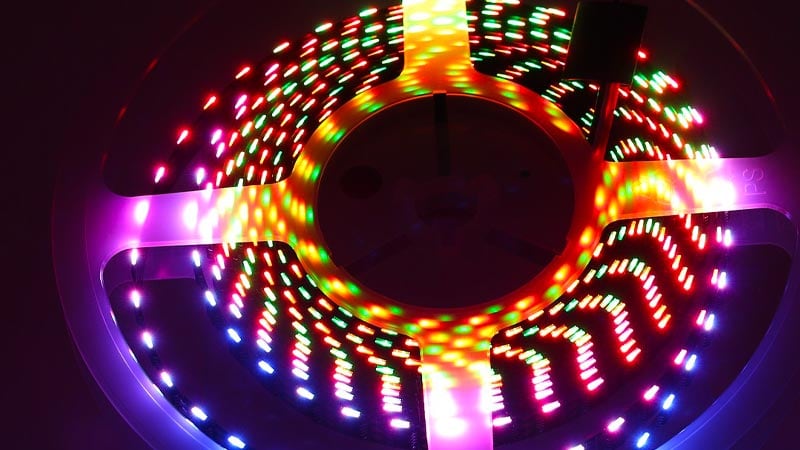
LED tape, also known as LED strip, is a very versatile and contemporary alternative to traditional light fittings. With a wide variety of brightness levels, colours and the flexibility to fit any space, it’s the ideal solution for signage, restaurants, hotels, bars and for your home. LED tape is very easy to install with a self-adhesive backing, all you have to do is simply peel and stick!
LED Tape For Diffused, Indirect Light Sources
Until recently, the principal source of lighting within business and residential spaces were down lights and spot lights. A revolution is taking place in this area, as many lighting designers are opting to use diffused, indirect light sources instead. Flexible LED strip is ideal for this application, allowing long unbroken lengths of light to completely illuminate the space.
Home LED Strip Lighting
In the home LED strip lighting can add a completely new dimension to all living spaces. In the kitchen, probably the most used room in the house, LED strip lighting perfectly accentuates the internal fittings. Because they are small, LED strip is ideal for under shelves and cabinets and their flexibility means they readily adapt to awkward shapes and curves.
LED Tape Solutions For Business
In commercial locations, LED tape offers many advantages over single fittings especially in hotels, restaurants and bars. The cost of installing large numbers of individual lights as demanded in public spaces is dramatically reduced. Using single colour and colour changing LED strip really brings to life and sets the tone for any location, ideal for use in ceilings, bar fronts and coving.
Where Can LED Tape Be Used
LED tape can be used pretty much anywhere. They can be fitted into cupboards, shelves, floors, coffers, stairs and many other places. With a low profile, they are an ideal lighting option to hide from view. IP65 rated waterproof LED strips are fantastic for both indoors and out. With a thin silicone layer on top of the flexible strip, these LED strips can withstand the elements. Waterproof strips are recommended for outdoor and garden lighting, swimming pool lighting, bathroom lighting and under cabinet lighting where moisture or dust can collect.
BULB REFERENCE GUIDE
CFL, Halogen, Linear, HID, Bulb Reference Chart
Light Bulbs, also known as lamps in the industry, come in a vast variety of sizes, shapes, and temperatures (colors) to allow for an array of fixtures, which need different bases and other considerations. stocks thousands of bulbs, including incandescent and halogen bulbs, CFL, Linear, and HID fluorescent bulbs as well as the latest technology with LED bulbs. Whether you’re using identical bulbs to replace those that have burned out or you’re upgrading to something more efficient or perhaps with a higher CRI, we’re here to guide you through the decision process with bulbs, fixtures, and lighting. Is a coveted floor lamp or chandelier fitted with a base you’ve never seen before? Or calls for a certain filament to get just right the glow? Read on if you’ve ever been confused on the right bulb shape for a certain project.
Bulb Size Reference Guide
How to use the chart: The code number of a bulb consists of a letter or letters followed by a number. The letter indicates the shape of the bulb and the number relates to the diameter of the bulb in eighths of an inch. The most commonly used household bulb is the A-19. The bulb is “A” type and the diameter would be 2 3/8″ A 120BR40 is a 120-watt reflector 5″ in diameter.
Color Temperature (Kelvins) Reference Guide
Here are some answers to questions about light bulb color temperature.
Warm light
2700k – 3000k
Warm, yellowish light that creates a smooth, personal, intimate and relaxing feel. Very similar light to that of an incandescent light bulb. Warm temperature light is great for homes, libraries, hotels, retail stores, and restaurants.
Cool light
3500k – 4100k
Cool light that creates a very friendly, inviting, non-threatening, neat, clean, and efficient feel. It is brighter than the incandescent cool white. Cool temperature light bulbs are great for executive offices, public reception areas, supermarkets, classrooms, and showrooms.
Daylight
5000k – 6500k
Daylight is a bluish white light that resembles noon on a cloudless day. This light is great for reading and accent lighting. Bright light bulbs like this a great for jewelry stores, hospitals, beauty salons, galleries, and museums.
Kelvin Associated Effects & Moods – Appropriate Applications
2700° Friendly, personal, intimate Homes, libraries, restaurants
3000° Soft, warm pleasing light – Homes, hotel rooms and lobbies, restaurants, retail stores
3500° Friendly, inviting, non-threatening Executive offices, public reception areas, supermarkets
4100° Neat, clean, efficient Office, classrooms, mass merchandisers, showrooms
5000° Bright, alert – Graphic industry, hospitals
6500° Bright, cool – Jewelry stores, beauty salons, galleries, museums, printing
BASIC L.E.D TERMINOLOGY EXPLAINED
There are a thousand and one different L.E.Ds out there that all have a role to play. Some sit atop a bull bar beaming light hundreds of metres ahead you, some illuminate your vehicle’s interior or dashboard. Then there are those that can be strapped on your head – allowing the use of both hands to work inside a dark engine bay.
The myriad of aftermarket L.E.D lighting options available to vehicle owners, be it driving lights, light bars, work lamps or strip lighting means at some point you’re likely to come across terminology that can be confusing for some. Performance is often marketed in lux, lumens, total watts or number of L.E.Ds multiplied by their individual power. Reliability is measured in standards like IP ratings and operating temperatures; then there’s current draw which is also important to consider for your electrical system.
We’re going to try and explain simply, some of these common L.E.D terms to help you make an informed purchase decision. So what is an L.E.D light? First up, LED stands for light emitting diode. This type of light is significantly more efficient than halogen light bulbs and lights up via a semiconductor that passes an electrical current through it. It has quickly become the most popular technology for aftermarket driving lights and many new vehicles’ factory lighting, with good reason.
Lumens
Many lights are promote their peak power output in wattage – the more watts, the more light, right? Well, not always. The power figure doesn’t speak to how efficiently this power is used by the L.E.Ds, or the product that they are contained within. How many “lumens” an L.E.D light has is a calculation (raw lumens) or measure (effective lumens) of how much light volume it can actually put out. The more the lumens, the more light. The humble household 60W globe has around 800 lumens, while most home lighting comes in at between 1,000 to 4,000 lumens depending on the room.
LUX
In conjunction with lumens, you’ll often find a specification called LUX. If lumens equal the volume of light emitted from the lamps, the LUX is the intensity or brightness of the light at a certain measured point in the distance. For example, Ultima 215 L.E.D has a LUX of 1 at 900m, meaning if you held a sheet of paper in front of the vehicle, 900m away, it would have 1 LUX of light failing on it. At 1 LUX, it is possible for the average person to read a newspaper. Using a combination of power, lumens and lux, you can more accurately determine and compare the performance of different L.E.D lights. But don’t forget to check beam patterns, as L.E.Ds can be angled or shone using different reflectors designed for different purposes.
IP Rating
The IP rating – standing for Ingress Protection – determines how water or dust proof the light is. There are a number of different levels of protection here. In the case of the Ultima 215 L.E.D Driving Light – which has an IP66 and IP67 rating – the L.E.Ds are protected from total dust ingress and is protected from powerful water jets from any direction and temporary immersion in water (for under 30minutes), so you know it can withstand a lot.
Light bulbs
Lighting has become something that’s easy to take for granted until a bulb goes out. When that time comes, the number of choices available is higher than it’s ever been. When shopping for light bulbs, you can sidestep the bans and continue using incandescent bulbs, despite their limited lifespan, so that you don’t have to give up the familiar glow you’re used to. Some have taken the first step to using energy-efficient lighting use compact fluorescent light (CFL) bulbs.
Compared to incandescent bulbs, CFL bulbs seemed like a great upgrade. However, the reduced power consumption and heat output came with two drawbacks. Many compact fluorescent light bulbs don’t achieve full brightness immediately or work well with dimmers. This has made it difficult for some to replace their incandescent lights until they could upgrade without these compromises; this is where LED lighting comes into play. When compared to incandescent and CFL bulbs, LEDs generate the same amount of light while using a fraction of the energy. LED bulbs turn on instantly to full brightness and last far longer.
Buying the right LED bulb is more than just adding one to your cart or picking one up off of a shelf. Below is a picture of an LED light bulb, the LED Lighting Facts for it, and the packaging. Each number is associated with different aspects you need to consider as you look for an LED bulb
LED Bulb Shapes
One of the most important things to know if you’re looking to buy a LED light bulb is the shape. When it comes to light bulbs, bulb shape designations have two parts made up of letters and a number. The letters describe the bulb type while the number is an indication of the actual size where a higher number represents a larger bulb size. These numbers are used to reflect the diameter of the bulb in multiples of 1/8th of an inch. LED bulbs can be broken down into four primary categories of shapes: A-shape, reflector, decorative, and specialty.
A-Shape
A-shape LED bulbs are the most common shape available and are commonly referred to as standard shape LED bulbs. An A19 bulb has a maximum diameter of 2 3/8th inches (19/8 = 2 3/8). This shape is commonly used for LED bulbs that replace incandescent bulbs up to 75 Watts. LED replacements for 100 Watts or higher typically have an A21 shape. You may also find some LED bulbs which use the smaller A15 shape.
Reflector
These bulbs are most commonly referred to as flood or spot light bulbs due to their reflective coating, which is used to create a wide or narrow beam angle. Reflector LED bulbs have the letter R in their bulb shape designation
LED Decorative Bulbs
Smaller than A-shaped bulbs, LED decorative bulbs are commonly found in wall sconces, chandeliers, and other decorative fixtures. These bulbs are designed to add to the look of your décor and provide ambient light.